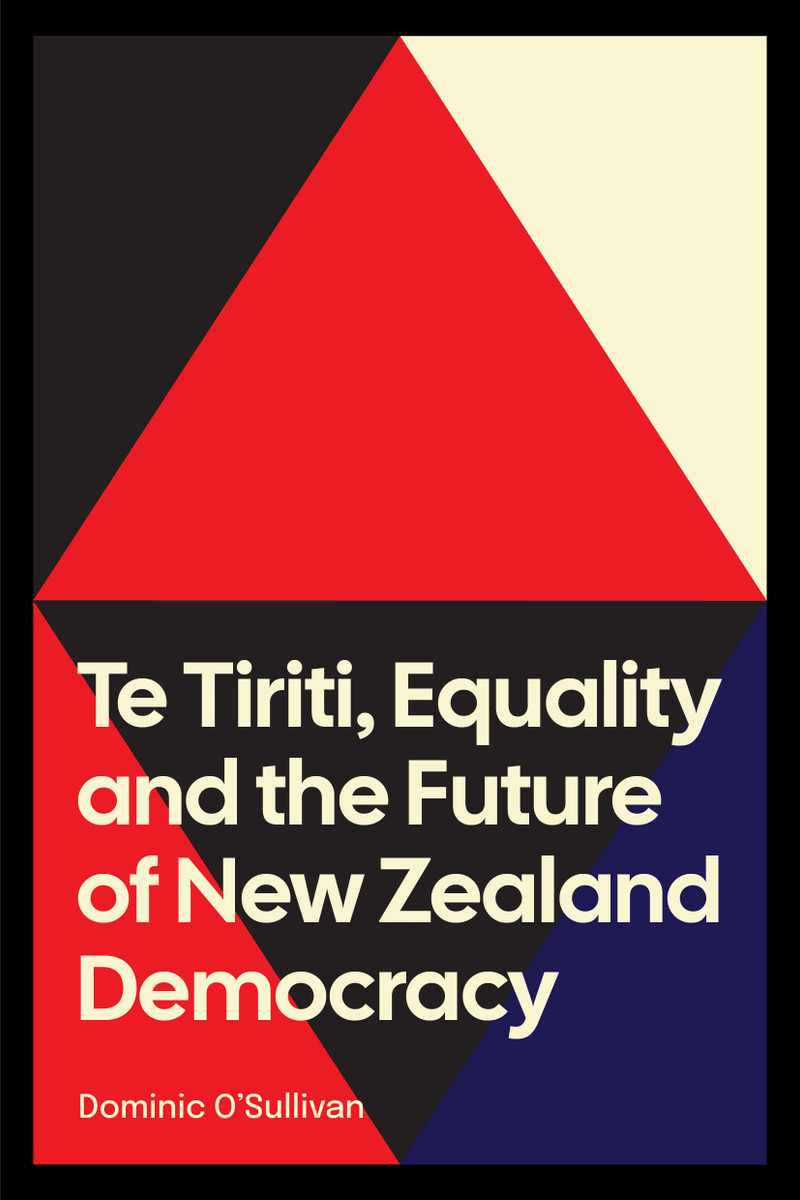
Te Tiriti, Equality and the Future of New Zealand Democracy
Dominic O'Sullivan
Author:
Dominic O'Sullivan
Format:
Paperback
Pages:
264
Published:
11 June 2026
Specs:
21.0cm x 14.0cm
ISBN:
9781776712366
A leading Māori intellectual charts our political future.
In this major work, the leading Māori political scientist Dominic O’Sullivan draws on theories of republicanism and the commonwealth to challenge understandings of Te Tiriti as a partnership between races, or between Māori people and the Crown. O’Sullivan also critiques the idea that Te Tiriti created one people, assimilating Māori into colonial ways of governing. Instead, he proposes a new politics where Māori self-determination and liberal democracy, rangatiratanga and kāwanatanga, complement one another to promote meaningful and culturally grounded political equality.
O’Sullivan enables us to see a future for Aotearoa in which political authority and responsibility belong to everyone and should therefore work equally well for all; a country where Māori people, as much as anyone else, bring their tikanga to public life; and a society where the Crown is no longer the word we use to describe government.
For scholars, policymakers and political leaders, for Māori and Pākehā, for all of us imagining a respectful and inclusive future for our island democracy, this is essential reading.
Author
Dominic O’Sullivan (Te Rarawa, Ngāti Kahu) is a political scientist and professor at Charles Sturt University in Australia. He is the author of eight books including Indigeneity: A Politics of Potential (Policy Press, 2017) and Sharing the Sovereign: Indigenous Peoples, Recognition, Treaties and the State (Palgrave Macmillan, 2020).
Endorsements
‘This will be a seminal book in Aotearoa New Zealand political and Māori scholarship. O’Sullivan moves beyond the weirdness of the Treaty principles and interminable originalist arguments. Instead, he provides a language grounded in republican ideals of non-domination and equality to debate the political morality of our current institutional arrangements. He thinks through the practical implications of rangatiratanga, mana motuhake and community control amongst iwi, hapū and other Māori political authorities – offering a new way of thinking about how we ought to live together, given the legacies of colonisation.’ — Lindsey Te Ata o Tū MacDonald, University of Canterbury, Te Whare Wānanga o Waitaha
‘I admire O’Sullivan’s work and think it is significant and timely. He explores the potential of deliberative democracy in a commonwealth that draws upon legacies from te ao Māori, the indigenous “world” as well as cosmopolitan modernity in a way that respects his own critique of “a simple Māori/Pākehā or kāwanatanga/rangatiratanga binary”. This holds great promise. As O’Sullivan argues throughout, the challenge is for deliberation and decision-making to be equally shared, rather than unilaterally imposed, as has too often been the case from the beginning.’ — Dame Anne Salmond, Waipapa Taumata Rau, University of Auckland
Reviews
- 'This is an important and thought-provoking work that deserves a wide readership. Whether one agrees with all of O’Sullivan’s conclusions or not, the book succeeds in elevating the conversation around Te Tiriti and democracy. It offers a compelling vision of a future in which political equality is strengthened, rather than threatened, by the meaningful expression of Māori authority and identity within public life.' – Chris Reed, NZ Booklovers
- Read an op-ed by Dominic in the Listener: 'For a political party wanting to bring treaty debate back to the centre – because that is where big parties maximise their vote and where polarising positions are countered – the simple manifesto aspiration might be for rangatiratanga to bring decision-making as close as possible to the people and for citizenship to work with equal tikanga, recognising that participation leads to better outcomes than performative culture wars.'
- 'I don’t try to present Te Tiriti as a rulebook, and I don’t try to convince people of a rigid process for managing relationships and for managing the state. But we do need to think about how to do things better and I hope that the book adds to the discussion.' – Dominic O'Sullivan, interviewed for NZ Booklovers
- 'Te Tiriti, Equality, and the Future of New Zealand Democracy is certainly a very thought-provoking book and offers quite a radical solution to the many of the challenges that Māori especially face in Aotearoa New Zealand today . . . perhaps the times we live in today demand radical solutions.' — Jatinder Mann, Journal of Australian, Canadian, and Aotearoa New Zealand Studies
Related products